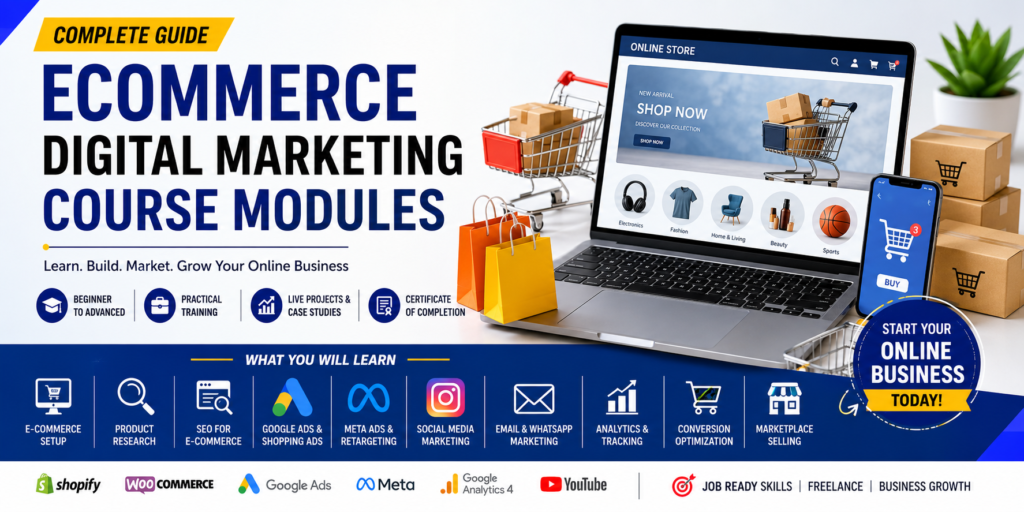
Ecommerce is growing rapidly in India, creating huge opportunities for students, job seekers, and business owners. If you want to start an online store or build a career in digital marketing, learning ecommerce modules is essential. This guide explains the complete Ecommerce Digital Marketing Course Modules that help you become job-ready and start earning online.
Introduction to Ecommerce
The course begins with understanding ecommerce fundamentals. You will learn what ecommerce is, different business models like B2B, B2C, and D2C, and how platforms like Amazon, Flipkart, and Shopify work. This foundation helps you understand how online businesses operate in real-world markets.
Ecommerce Website Setup
Next, you will learn how to build your own online store. This includes domain and hosting setup, creating websites using WordPress with WooCommerce, and Shopify store development. You will also understand user-friendly design (UI/UX) and mobile optimization, which are crucial for increasing sales. ENROLL NOW
Product Research and Niche Selection
Choosing the right product is key to success in ecommerce. In this module, you will learn how to find trending and profitable products, analyze competitors, and select the right niche. You will also understand pricing strategies and the difference between dropshipping and inventory-based businesses.
Product Listing Optimization
A good product listing increases conversions. This module teaches you how to create SEO-friendly product titles, write high-converting descriptions, and use high-quality images. You will also learn keyword research techniques to improve visibility on search engines and marketplaces.
Ecommerce SEO (Search Engine Optimization)
SEO is essential for organic traffic. You will learn on-page SEO for product and category pages, technical SEO for improving website speed and performance, and off-page SEO strategies like backlinks. This module also covers Core Web Vitals to enhance user experience and rankings.
Paid Advertising for Ecommerce
To scale your business quickly, paid ads are important. This module covers Google Ads (Search, Display, and Shopping), Meta Ads (Facebook and Instagram), and YouTube Ads. You will also learn retargeting strategies, conversion tracking, and how to measure ROI and ROAS.
Social Media Marketing
Social media plays a big role in ecommerce success. You will learn how to set up Instagram and Facebook Shops, create engaging content, and run influencer marketing campaigns. Short video marketing using reels and brand-building strategies are also included.
Marketplace Selling (Amazon & Flipkart)
Selling on marketplaces is a powerful way to generate revenue. This module covers seller account setup, product listing, inventory management, pricing strategies, and how to optimize reviews and ratings to increase sales.
Payment Gateway and Logistics
Smooth payment and delivery systems are essential for customer satisfaction. You will learn how to integrate payment gateways like Razorpay and Paytm, manage COD and prepaid orders, and set up shipping, returns, and tracking systems.
Conversion Rate Optimization (CRO)
Getting traffic is not enough—you need conversions. This module teaches sales funnel optimization, checkout improvements, A/B testing, and strategies to reduce cart abandonment. You will also learn upselling and cross-selling techniques to increase revenue.
Email and WhatsApp Marketing Automation
Customer retention is key for long-term success. You will learn how to create email campaigns, automate WhatsApp marketing, and use CRM tools. Personalized marketing strategies help improve customer engagement and repeat sales.
Analytics and Tracking
Data-driven decisions improve performance. This module includes Google Analytics (GA4), Google Tag Manager, and conversion tracking. You will learn how to analyze sales data and optimize campaigns based on performance insights.
Advanced Ecommerce Strategies
In the final stage, you will explore advanced concepts like dropshipping, print-on-demand, AI tools for marketing, and scaling your ecommerce business globally. These strategies help you grow faster and stay competitive.
Live Projects and Practical Training
A good course includes hands-on experience. You will build your own ecommerce store, run live ad campaigns, and work on real case studies. This helps you create a strong portfolio and become job-ready.
Conclusion
An Ecommerce Digital Marketing Course equips you with the skills to start your own online business or get a high-paying job. From website creation to running ads and analyzing data, these modules cover everything you need to succeed in today’s digital world. If you are serious about building a career or growing your business, learning ecommerce is one of the best investments you can make.